

- Singapore Haze Today: What Should You Check?
- PSI vs PM₂.₅: What's the Difference?
- What Do the PSI Levels Mean?
- What Causes Haze in Singapore?
- Why is PM₂.₅ important during haze?
- How to Protect Yourself During Singapore Haze?
- How to Protect Indoor Air During Haze?
- How to Choose an Air Purifier During Haze?
- Protecting Children, Elderly Family Members and Vulnerable People
- Singapore Haze Preparation Checklist
- Bottom Line:
Singapore experiences transboundary smoke haze from time to time, particularly when dry conditions, regional fires and prevailing winds combine to carry smoke towards Singapore.
During a haze episode, knowing what the air-quality readings mean — and what to do with that information — can make it easier to manage everyday activities at home, outdoors and at work.
This guide explains the Singapore haze situation, the difference between PSI and PM₂.₅, when outdoor activity should be reduced, how to protect indoor air, when an N95 mask may be appropriate, and how households can prepare.
Important: Air-quality conditions can change quickly. Always refer to the latest advisories from Singapore’s National Environment Agency (NEA), the haze microsite and the myENV app for current readings and health guidance.
Singapore Haze Today: What Should You Check?
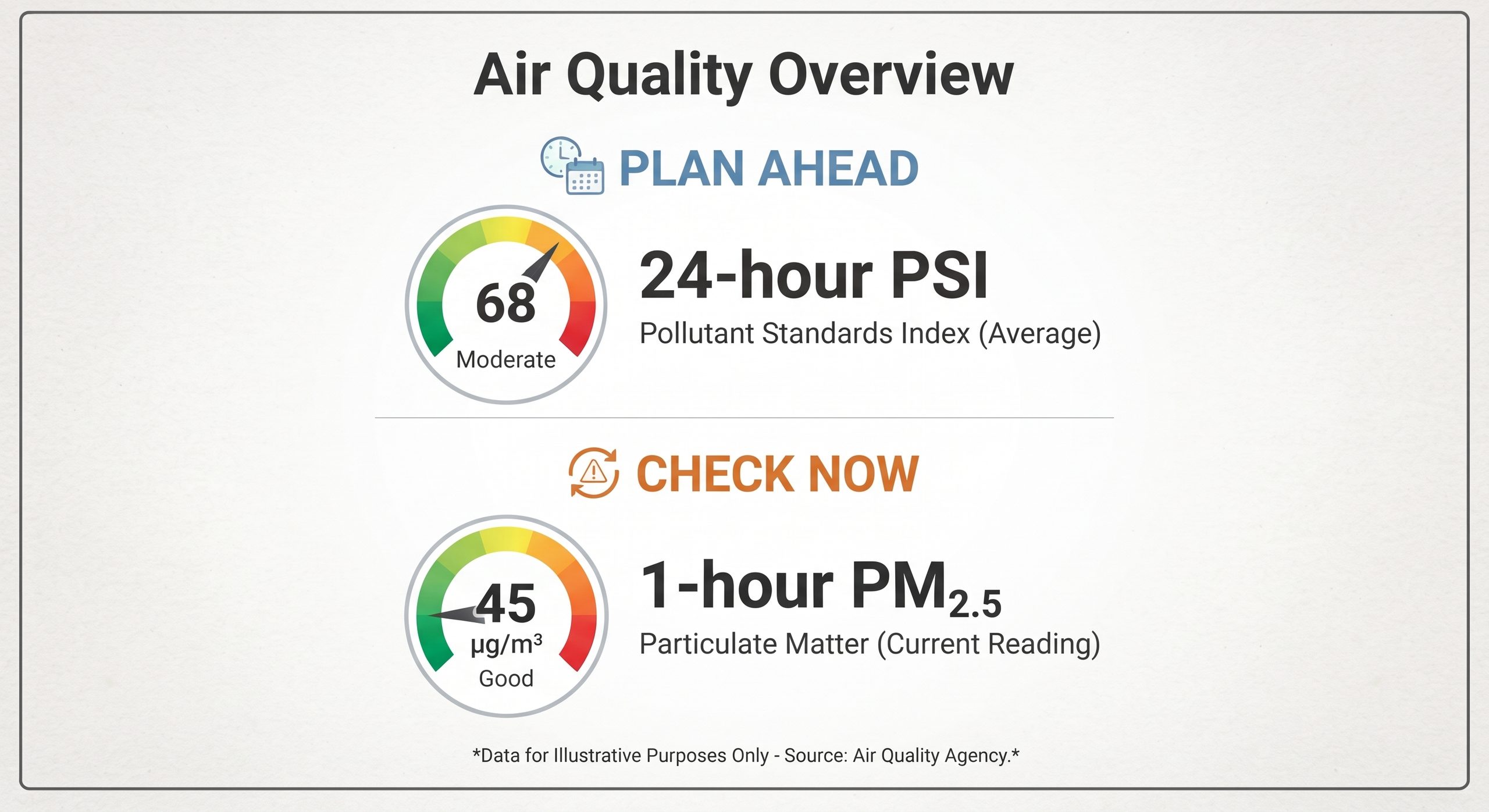
During an active haze period, there are two numbers that are particularly useful:
24-hour PSI — useful for planning ahead.
1-hour PM₂.₅ — useful for immediate outdoor activities.
NEA advises using the 24-hour PSI forecast and accompanying health advisory when planning activities for the following day, while the 1-hour PM₂.₅ reading should be checked for immediate activities.
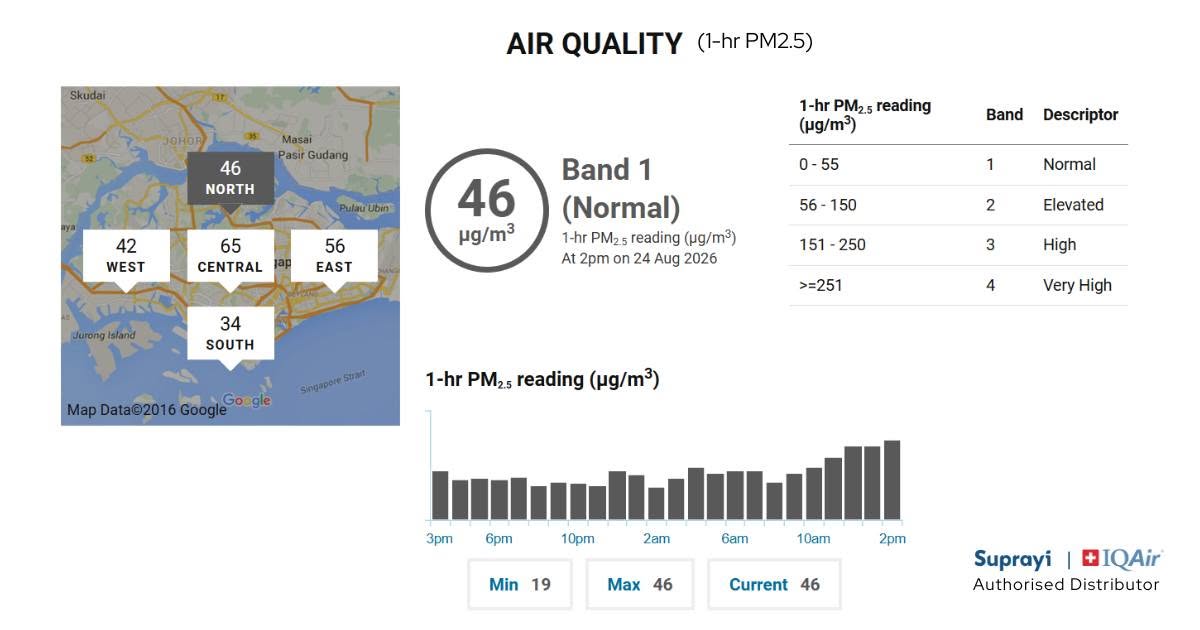
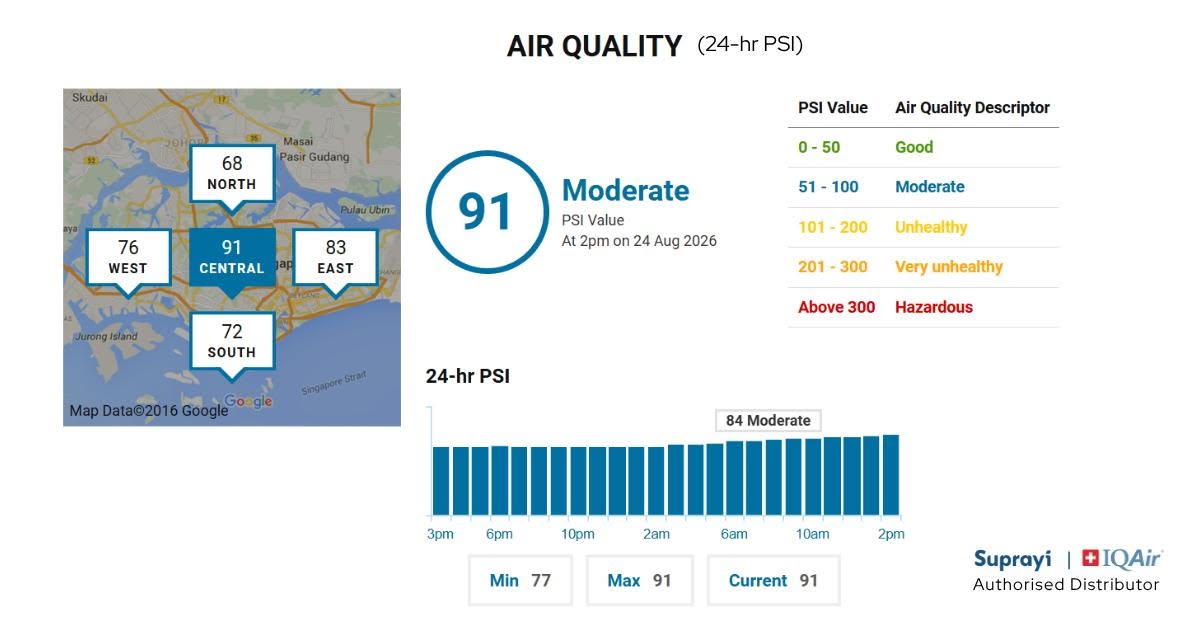
At 9am to 10am on 11 September 2026, NEA reported 1-hour PM₂.₅ readings of 22-42 µg/m³ and a 24-hour PSI of 74–95 across Singapore’s regions. Smoke plumes from fires in southern and central Sumatra and Kalimantan continued to drift towards Singapore, with dry conditions and prevailing winds creating a continuing risk of haze.
Because these readings change, this section should be updated during an active haze episode rather than treated as permanent information.
PSI vs PM₂.₅: What’s the Difference?
The two measurements serve different purposes.
24-hour PSI: Plan ahead
The 24-hour Pollutant Standards Index (PSI) provides an overall indication of air quality and is used with the health advisory to help people plan activities.
For example, if the forecast indicates that the PSI is likely to enter the Unhealthy range the following day, an outdoor event involving prolonged physical activity may need to be reconsidered.
1-hour PM₂.₅: Check current conditions
The 1-hour PM₂.₅ concentration provides a more immediate indication of fine-particle levels.
NEA recommends checking the 1-hour PM₂.₅ reading when deciding about activities taking place in the next few hours.
What Do the PSI Levels Mean?
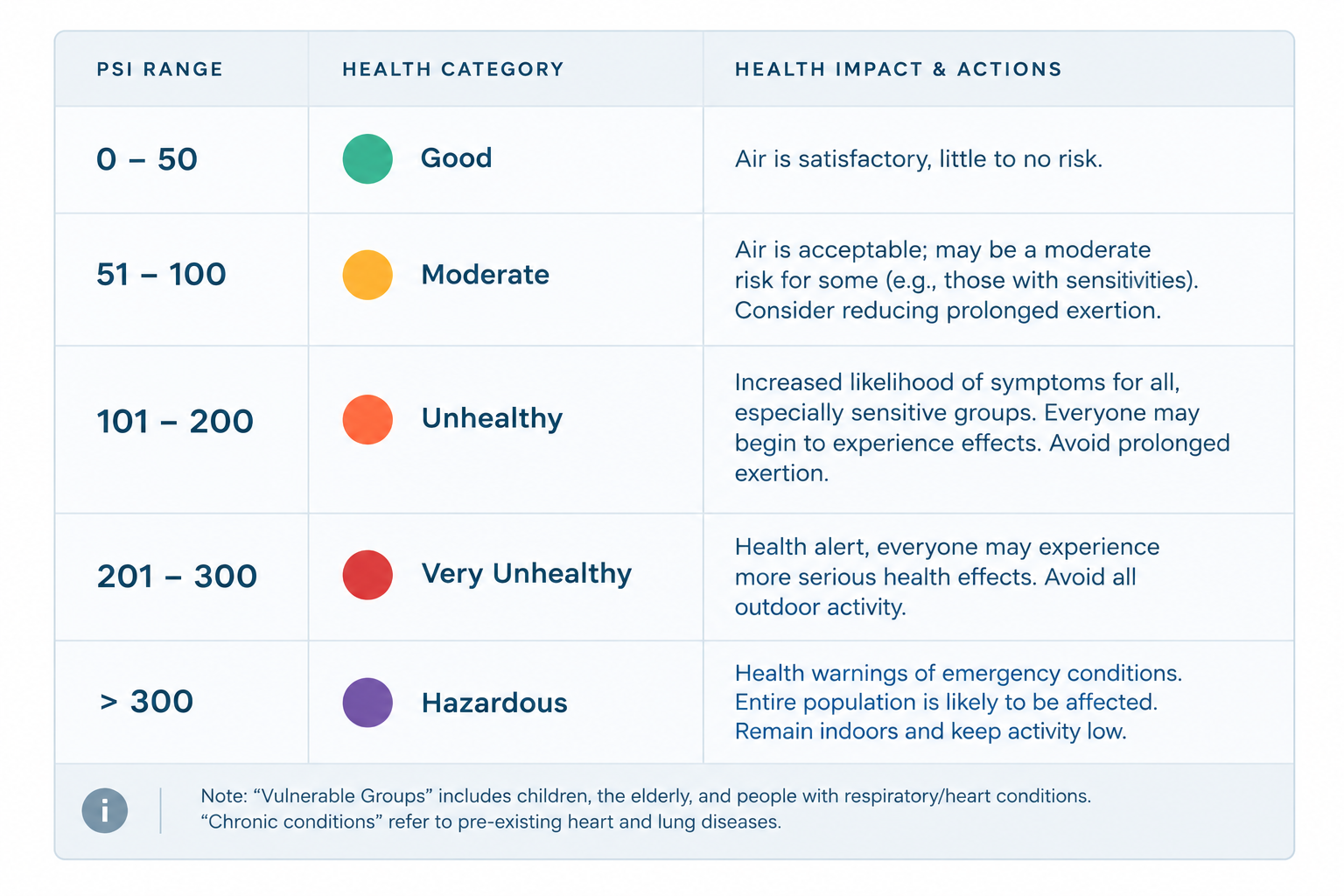
A PSI reading of 101 and above is considered Unhealthy. However, the PSI level does not mean that everyone should follow the same routine. NEA’s health advisory also considers whether someone is healthy, elderly, pregnant, a child, or has chronic heart or lung disease.
What should you do at each PSI level?
Good to Moderate — PSI 0–100
For healthy people, normal activities are generally appropriate. Children, elderly people, pregnant women and people with chronic heart or lung conditions can also follow normal activities at these levels, subject to their individual circumstances and current health advice.
Unhealthy — PSI 101–200
Healthy people should reduce prolonged or strenuous outdoor physical exertion. Children, elderly people and pregnant women should minimise prolonged or strenuous outdoor physical exertion. People with chronic heart or lung disease should avoid prolonged or strenuous outdoor physical exertion.
Very Unhealthy — PSI 201–300
Healthy people should avoid prolonged or strenuous outdoor physical exertion. Children, elderly people and pregnant women should minimise outdoor activity. People with chronic hearts or lung disease should avoid outdoor activity.
Hazardous — PSI above 300
Healthy people should minimise outdoor activity. Children, elderly people, pregnant women and people with chronic heart or lung disease should avoid outdoor activity. The key point is that there is no single PSI number at which every person must simply “stay indoors”. The appropriate response depends on the individual, the air quality, and what they are doing outdoors.
What Causes Haze in Singapore?
Singapore haze is primarily associated with smoke from regional forest and land fires.
During periods of dry weather, fires can occur in parts of the region. When prevailing winds carry the resulting smoke across national boundaries, Singapore can experience transboundary smoke haze.
NEA notes that haze can be worsened by dry seasons, changes in wind direction and low precipitation. The Southwest Monsoon season can also bring conditions in which smoke haze from regional fires is transported towards Singapore.
Recent 2026 haze updates have reported smoke plumes from parts of Sumatra and Kalimantan drifting towards Singapore.
Why is PM₂.₅ important during haze?
Fine particulate matter, or PM₂.₅, is the main pollutant of concern during periods of smoke haze.
PM₂.₅ refers to fine particles with a diameter of 2.5 micrometres or smaller. These particles can enter buildings through fresh-air intakes, openings and gaps, meaning that indoor air quality can also be affected during a haze episode.
How to Protect Yourself During Singapore Haze?
The simplest way to reduce haze exposure is to reduce the amount of polluted air you breathe.
When air quality deteriorates, consider reducing prolonged outdoor activities and strenuous physical exertion, according to the official health advisory.
For people who exercise outdoors, this may mean moving a workout indoors. For families, it may mean postponing prolonged outdoor play or activities when conditions become unhealthy.
For people who work outdoors or spend several hours outside, the risk assessment is different from someone making a short commute.
Always consider:
- the current 1-hour PM₂.₅ reading;
- the forecast 24-hour PSI;
- how long you will be outside;
- how strenuous the activity is;
- your individual health status
How to Protect Indoor Air During Haze?
Staying indoors can reduce exposure, but indoor air should not automatically be assumed to be unaffected by outdoor haze.
NEA notes that PM₂.₅ can enter air-conditioned buildings through fresh-air intakes, openings and gaps. During prolonged haze, indoor particulate levels can accumulate.
Practical steps include:
1. Keep outdoor air from entering unnecessarily
When haze conditions are poor, keep windows and doors closed where appropriate.
2. Pay attention to ventilation and air-conditioning
Understand whether your building or air-conditioning system introduces outdoor air and follow the relevant building or equipment guidance.
3. Use suitable air cleaning
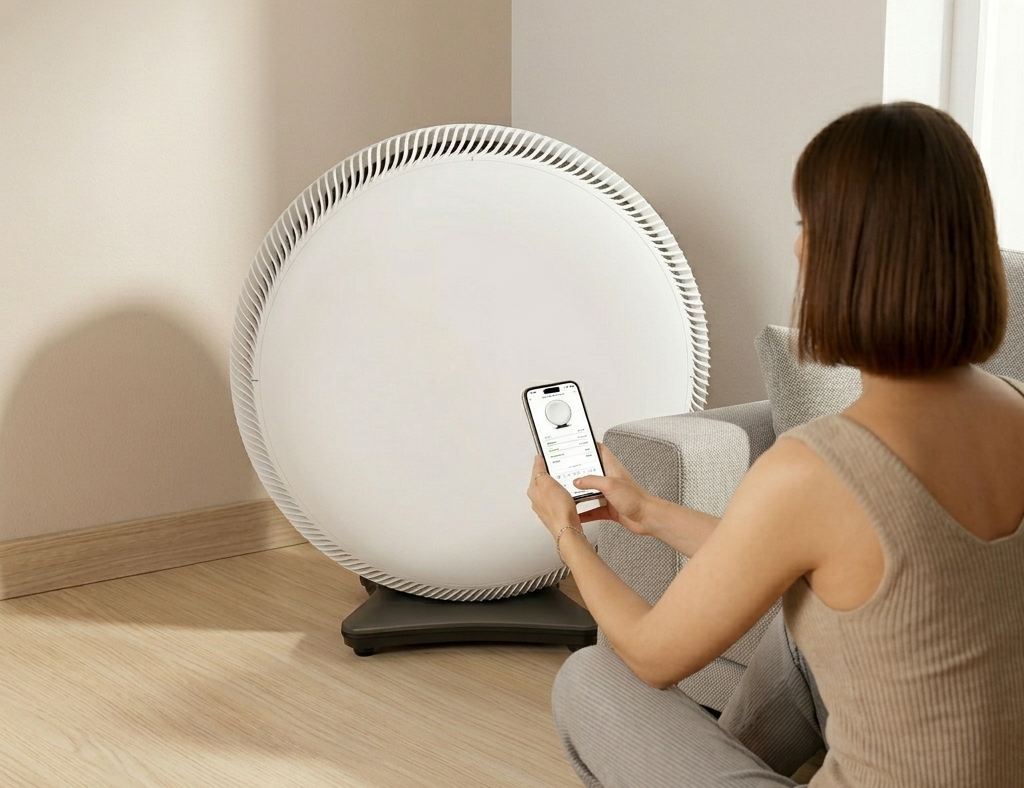
A portable air cleaner can help reduce particulate levels inside an enclosed space. NEA recommends considering Clean Air Delivery Rate (CADR) together with room size when selecting a portable air cleaner for smoke-haze protection.
4. Keep the room and purifier properly maintained
A purifier works as part of an overall indoor-air strategy. Filter condition, airflow and appropriate sizing all matter.
How to Choose an Air Purifier During Haze?
If you are considering an air purifier for haze, avoid choosing a device based only on appearance or the word “HEPA” on the packaging.
Consider:
Room size
A purifier should be appropriate for the space in which it will operate.
Clean-air delivery
CADR is one useful measure of how much clean air a portable air cleaner can produce.
Particle filtration
During smoke haze, fine particles such as PM₂.₅ are an important consideration.
Airflow and placement
The purifier needs unobstructed airflow and should be positioned appropriately within the room.
Filter maintenance
A filtration system needs to be maintained according to the manufacturer’s instructions.
For a more detailed explanation of how to select an air purifier specifically for Singapore homes during haze, see our guide:
How to Choose an Air Purifier for Singapore Haze
Protecting Children, Elderly Family Members and Vulnerable People
Some people may be more affected by haze than others.
NEA’s health advisory specifically identifies:
- children;
- elderly people;
- pregnant women;
- people with chronic heart disease;
- people with chronic lung disease
as groups for whom outdoor activity guidance becomes more restrictive as PSI levels rise.
Families can prepare by checking the forecast before planned outdoor activities, keeping necessary medication readily accessible where appropriate, and monitoring anyone who becomes unwell.
People who feel unwell, particularly children, elderly people and those with chronic heart or lung conditions, should seek medical attention.
Singapore Haze Preparation Checklist
Before haze conditions worsen, households can prepare a few simple things:
☐ Know where to check the latest PSI forecast
☐ Check 1-hour PM₂.₅ before outdoor activities
☐ Keep windows and doors closed when appropriate
☐ Understand your home’s air-conditioning or ventilation setup
☐ Check that your air purifier is working properly
☐ Check filter condition and replacement requirements
☐ Have suitable masks available if required
☐ Keep necessary medication accessible
☐ Plan indoor alternatives for prolonged outdoor activities
☐ Check on children, elderly family members and other vulnerable household members
Bottom Line:
Singapore haze can change quickly, but the basic response is straightforward: stay informed, reduce exposure when advised, and pay attention to the air inside your home as well as outside it.
Use the 24-hour PSI to plan ahead and the 1-hour PM₂.₅ reading to assess immediate outdoor conditions.
During unhealthy or worse conditions, follow the official health advisory and take additional precautions if you or your family members are more vulnerable to the effects of haze.
For indoor environments, an appropriately selected and maintained air purifier can form part of a broader strategy to manage particulate levels.
For the latest conditions, always refer to Singapore’s official haze and air-quality information.
Official Singapore resources :
This article provides general information about managing exposure to haze and is not a substitute for medical advice. Follow the latest guidance from Singapore’s health and environmental authorities.